

Launched in 2012, the Investing with Impact Platform includes a wide range of investment and manager options across public and private markets, allowing our institutional consultants to strategically integrate mission alignment and impact throughout their clients’ entire investment portfolios. Our comprehensive spans across public and private markets and guides values-aligned portfolio construction in line with our framework, or The Three I’s of Impact – Intentionality, Influence and Inclusion.
Over the past decade, Morgan Stanley has developed technology and quantitative tools to help clients make the best possible decisions and help achieve their impact goals without sacrificing potential returns. Available exclusively to Morgan Stanley clients, Morgan Stanley Impact Quotient® is our proprietary, patented impact reporting tool that captures clients’ unique impact priorities and assesses alignment across multiple dimensions.
Whether you’re just beginning to consider aligning your organization’s capital to your mission or impact goals or are already transitioning to a more proactive focus across your organization, we have the skills, expereince, and tools to bring clarity and structure to your vision.
Investing with Impact Framework
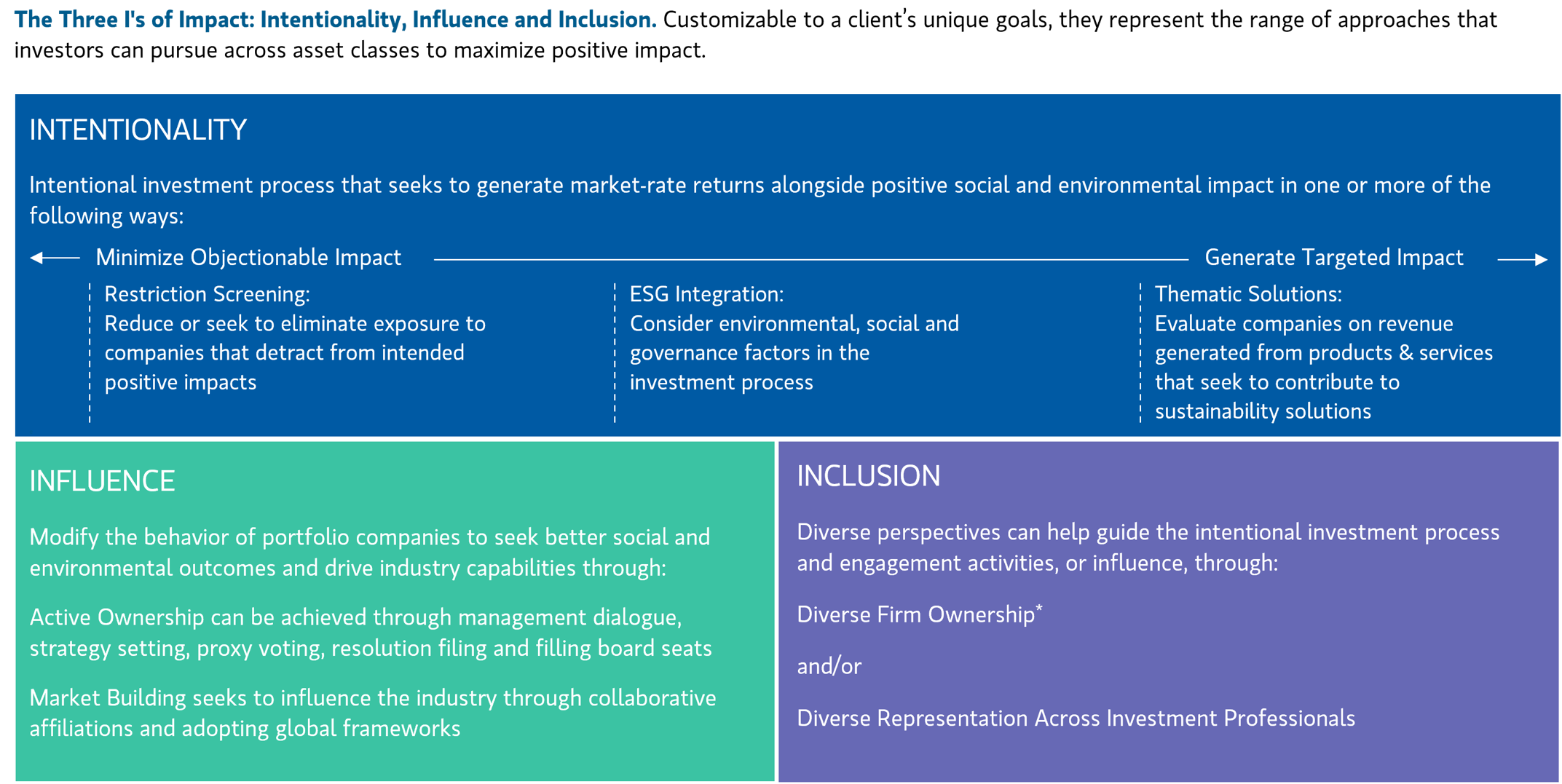
* Morgan Stanley’s Global Investment Manager Analysis team defines diverse asset managers as those with 33% or greater ownership by women and/or racially/ethnically diverse individuals. The categories that make up the racially/ethnically diverse individuals as defined by Morgan Stanley align with those of the U.S. Equal Employment Opportunity Commission and includes: Hispanic or Latino, Black or African American, Asian, American Indian or Alaska Native, or Native Hawaiian or other Pacific Islander.
Source: Morgan Stanley Wealth Management Investing with Impact
Check the background of our Firm and Investment Professionals on FINRA's Broker/Check.*
Private Funds (which include hedge funds and private equity funds) often engage in speculative investment techniques and are only appropriate for long-term, qualified investors. Investors could lose all or a substantial amount of their investment. They are generally illiquid, not tax efficient and have higher fees than many traditional investments.
Investing in the market entails the risk of market volatility. The value of all types of investments may increase or decrease over varying time periods. Fixed Income investing entails credit risks and interest rate risks. When interest rates rise, bond prices generally fall.
The Morgan Stanley Impact Quotient report is an assessment of an investor’s portfolio (or subset thereof) utilizing various environmental, social, and governance (“ESG”) factors. The metrics included in the report are based on key topic areas for sustainable and impact investing. Assessment of the investor’s portfolio's alignment with ESG factors, established by Morgan Stanley, is evaluated based on available data and expertise from MSCI ESG Research, ISS-ESG and Fossil Free Indexes.
The Morgan Stanley Impact Quotient report does not represent Morgan Stanley's view of any individual fund or security, is not a judgment on any company's commitment to sustainability issues, and is provided for informational purposes only. The report is not a “research report” as defined by FINRA Rules 2241 and 2242. It is not prepared by the Research Departments of Morgan Stanley Smith Barney LLC or Morgan Stanley & Co. LLC or its affiliates.
Environmental, Social and Governance (“ESG”) investments in a portfolio may experience performance that is lower or higher than a portfolio not employing such practices. Portfolios with ESG restrictions and strategies as well as ESG investments may not be able to take advantage of the same opportunities or market trends as portfolios where ESG criteria is not applied.
There are inconsistent ESG definitions and criteria within the industry, as well as multiple ESG ratings providers that provide ESG ratings of the same subject companies and/or securities that vary among the providers. Certain issuers of investments may have differing and inconsistent views concerning ESG criteria where the ESG claims made in offering documents or other literature may overstate ESG impact. ESG designations are as of the date of this material, and no assurance is provided that the underlying assets have maintained or will maintain and such designation or any stated ESG compliance. As a result, it is difficult to compare ESG investment products or to evaluate an ESG investment product in comparison to one that does not focus on ESG. Investors should also independently consider whether the ESG investment product meets their own ESG objectives or criteria.
There is no assurance that an ESG investing strategy or techniques employed will be successful. Past performance is not a guarantee or a dependable measure of future results.
CRC#5500254 (06/2026)